
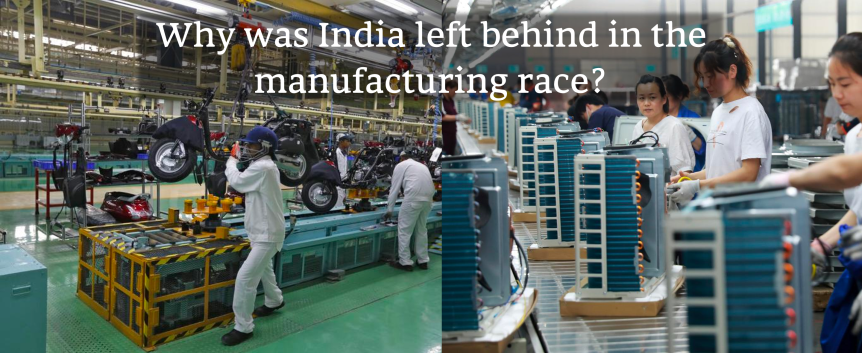
China is lightyears ahead of India, or any other nation, in manufacturing. China’s manufacturing sector is 10x that of India and total exports are 7.5x.
The current COVID-19 crisis has sparked debate about global corporations moving their manufacturing base away from China. The most obvious benefitter for this would be India, so much so that some propaganda news channels have declared that the process is already underway.
However, for any realistic shift to happen, India needs to address a few structural and political deficiencies.
Structural
Infrastructure: Total area dedicated to Special Economic zones in India is 47,990 Hectares. In comparison, China’s largest SEZ – Shenzhen – has an area of 49,300 hectares. India lags significantly behind in terms of Infrastructure – investment accounts for 30% of GDP (compared to 50% in China). When adjusting for the size of the economies, the difference in absolute dollar amounts is even more stark.
Further, utilities are highly subsidized for the agriculture sector in India. This means that industries end up paying a premium (which can result in electricity more expensive than developed nations).

Road network: While India has a considerably larger road network compared to China, the quality is significantly lower. India’s expressway network is less than 1% that of China’s and national highways account for less than 3% of Indian roads (40% in China). Of these 3%, a further 75% are two-lanes or fewer wide.

Railways: India fares worse in railways than in roads. The network is slightly smaller compared to China. However, despite the fuss over the recent launch of ‘bullet trains’ in India, no Indian train can be classified as high speed by International standards. In comparison, almost 30% of China’s railway network is high speed (the largest in the world).
These deficiencies in logistics mean that sourcing goods from China can at times be cheaper and faster than buying from an Indian supplier.
Labor: India’s average hourly manufacturing labor cost is $2.5 (compared to $4.8 for China). However, to understand if this really is an advantage, let’s look at the two countries’ manufacturing mix:

India’s exports are heavily composed of industries requiring less skilled labor such as mineral fuels, gems and chemicals. China, on the other hand, relies more on ‘machinery’ manufacturing. To transform India’s manufacturing mix, labor upskilling would be needed thereby increasing the labor costs. Thus, the real difference might not be as large as it seems.
Political
Political structure: There is no dearth of criticism for China’s communist party. However, the political structure has certainly played to its advantage in inviting global firms to set up manufacturing hubs.
For International firms setting up base in either country, a key challenge is navigating the regulatory process. This process has been made excessively complicated by bureaucrats, allowing them to extract bribes for helping navigate it.
While this is true for both India and China, who to bribe (the ruling party) changes from state to state in India, and those too could change every 5 years. On the contrary, in China it was and has been constant. Because global firms are looking for greater political stability, not a better political regime, China is the clear winner.
Of course, following China is not an option here. While predictable corruption worked for China, India needs to focus on eliminating corruption and red tapism.
Policies: Both nations adopted the SEZ (Special Economic Zones) route to boost manufacturing and export. While India was the first mover, China’s SEZ was significantly more effective. China’s SEZs were modern megacities designed to attract FDI. Each SEZ had a local political head who primarily had 2 jobs – design FDI friendly policies for the SEZ and help the foreign investor navigate the regulatory system.
On the contrary, Indian SEZs were meant to attract local investors who would manufacture and export via the SEZ. Moreover, while the SEZs had favorable policies, they lacked the necessary infrastructure which led to ghost companies located in the SEZ on paper but really operating from other locations.
Should India take the China route? A desperate attempt at loosening policies to attract foreign investors might lead to weak labor protection laws (as seen in Nike sweatshops). Therefore, a balance must be striked.
Conclusion
Win-win?
The above arguments assume that for India to rise as the champion, it would need to beat China. That might not necessarily be the case. Xi Jinping’s “Made in China 2025” campaign aims to pivot China from labor intensive manufacturing to technology intensive sectors such as robotics & aerospace. As China pivots to innovation, India can fill in the gaps for mass production.
Should India skip strengthening manufacturing and move directly to innovation?
India should certainly focus on innovating. The tech and startup culture in India has been booming and will continue to do so. However, a strong manufacturing sector is essential to absorb the masses in a country as populated as India and reduce inequality.
What are your thoughts on this? What issues do you think were left out or would be interesting to further explore? Drop a message in the comment section below!

 Plain Vanilla Finance
I really liked how you brought out the political aspect of the topic which is relatively less explored on other sources!
The article covers the topic very efficiently. Kudos to the author.
Also I think instead of waiting for China’s manufacturing sector’s decline, India should really work on improving its own infrastructure and make things easier for the manufacturers, as other countries in south east asia are also developing their manufacturing sector rapidly.
LikeLiked by 1 person
Completely agreed Gaurav. Other SE Asian countries attracting any potential outflow from China could seriously hamper India’s manufacturing growth.
Thank you for the wonderful words!
LikeLike
Great analysis! Loved the comparison of political structure
LikeLiked by 1 person