
There’s no dearth of companies trying to exploit technology to provide leaner, more personalised solutions for their customers. Thousands have gone down the automation path, but few have found enlightenment. Each year, millions of dollars are spent on developing AI and ML capabilities, but much of it is in vain.
In a sea of moderately-successful companies flaunting mediocre technology, Ocado is an exception. Founded 20 years ago in the U.K., it started off an online grocery retailer. Only two decades into the grocery business, Ocado is credited with making online grocery retailing finally work and is giving the likes of Auchan and Carrefour a run for their money. How did Ocado revolutionise and glamorise something as mundane as shopping for yogurt? Let’s find out.
Ocado’s Business Model & Evolution
Ocado has zero brick-and-mortar stores — yet it manages to promise 24h delivery to more than 75% households in the U.K. with 99% accuracy. In 2019, Ocado sold 50% of its online retail business to M&S and officially became a technology powerhouse. According to Ocado’s Chief Technology Officer, “Ocado is now a solutions provider that runs on the intersection of IoT, big data, cloud, robotics and AI.”
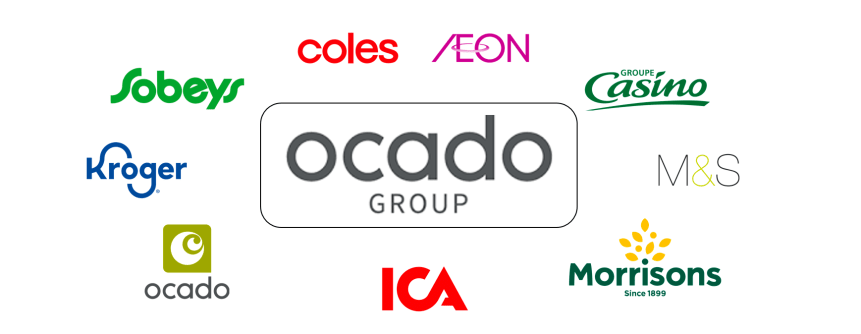
Ocado’s bold transformation into a technology company is what’s causing all the fuss. Ocado has already created a sophisticated platform that powers its own on-demand grocery service. With an annual turnover of £1.6 Bn, it now also builds everything from consumer-facing websites to robot-operated fulfilment centres for other food retailers. Its clients include, but are not limited to, Kroger in the U.S., Groupe Casino in France and Aeon in Japan.
That’s an impressive list of clients for a company that’s still in the red.
Many supermarket chains that have an online ordering option have built ‘dark supermarkets’ or warehouses, that not only look like a supermarket — with rows and rows of shelves stocked with an assortment for thousands of different products, but also replicate all its inefficiencies such as long lead time, low fulfilment accuracy and high working capital requirement.
So what is Ocado really doing for its clients (and for itself)? Let’s take a closer look at the inventive company’s workflow to see how exactly it leverages automation, robotics and advanced analytical capabilities to bring benefits to others in the food retail sector and beyond.
Step 1: Placing orders
Highly intuitive interface
Ocado’s boasts a highly intuitive interface that makes ordering 50 items seem like a breeze. The platform is highly tech enabled — the first in the U.K. to allow users to place orders via Alexa, and the only one to have predictive search functionality underpinned by advanced data science.
Step 2: Order processing
Demand forecasting
Ocado knows what will be ordered and when it will be ordered: this demand forecasting ensures the right supply of products to its warehouses and allows Ocado to maintain the right inventory. As a result, Ocado holds only 7 days of inventory at a time, compared to an industry average of 27 days.
Step 3: Order fulfilment
Warehousing
Since it has no brick & mortar stores, all deliveries are coordinated from its four main warehouses in the U.K. But these aren’t your average warehouses that dot the countryside. Ocado’s customer fulfilment centres (CFCs) are one of the most sophisticated and automated on the planet, and each one can handle many tens of thousands of orders a week.
There are over a 1000 robots canvassing the warehouse floors among 50k+ products, moving groceries day and night. These robots are capable of collaborating to pick a typical 50-item order in under 5 minutes. Items are still placed in crates, and those crates are stored in huge stacks. Their position in the stack seems random — a box of razors next to toilet paper, for example — but it’s algorithmically decided; with frequently accessed items placed on the top and rarer purchases near the bottom. Such super-efficient picking and packing systems have helped reduced lead times and make Ocado the world’s biggest online-only supermarket.

There’s many, many other reasons why Ocado warehouses would blow the minds of even hardwired techies. Visit Ocado’s website to know more.
Using predictive analytics
All this is nice and good, but how does a futuristic warehouse help Ocado fulfil orders with ~99% accuracy? Highly intelligent algorithms can predict baskets (before actual orders are placed) which means that Ocado can start preparing baskets before orders for the day start to flow in. This again ensures shorter lead times.
Step 4: Deliveries
Using advanced telematics
Ocado’s last mile routing technology ensure delivery efficiency. Ocado obviously tracks its delivery vans using GPS. But not only that. It also records other analytical data, such as fuel usage and braking. Variations are made for date and time of delivery, as road conditions are likely to differ on a Monday morning and Sunday afternoon.
The system is so sophisticated that when a van pulls up outside your house, Ocado records how much time it takes to find your house and complete the delivery. If the dwell time is longer than average, the system figures that you live somewhere hard to find. Next time you order, Ocado’s scheduling software budgets more time for your delivery.
Ocado — Microsoft of retail?
From taking orders to delivering them — every aspect of Ocado’s workflow is infused with a culture of testing and evaluation in a quest for greater efficiencies and optimisations that can be made. Now that Ocado has honed its skills in a particular sector — food retail, it is ready to open its technological platform to other retailers and offer end-to-end software and hardware solution as a managed service.
Ocado has staked its future on selling software and robots to other retail companies — it would be fascinating to see if the bet pays off.

 Plain Vanilla Finance