The COVID-19 crisis is the biggest health crisis in over a century. The world is under lockdown, taking away the one thing that no business can live without – clients. While most companies are trying to make ends meet and hoping this passes away soon, some have pivoted their business models to embrace the change. Let us explore what companies, small and large alike, are doing to not only survive but also evolve during the crisis.
Fresh revenue streams
Here are some businesses that repositioned to maintain a steady stream of revenue during the crisis:
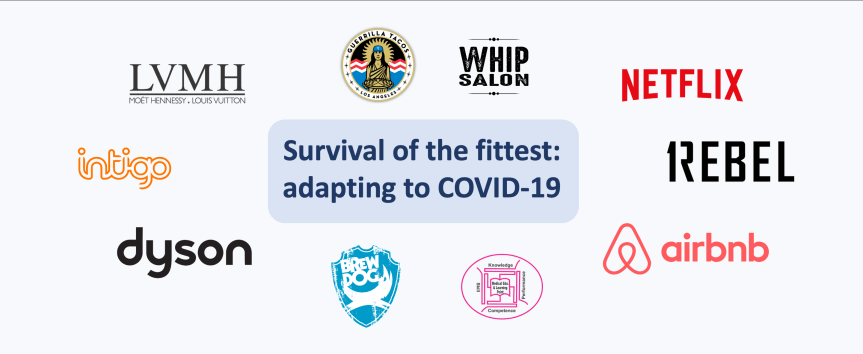
IntiGo: A Tunisian taxi startup is now delivering groceries (among other products) to its customers for $4/hour.
Netflix: They were the clear winners of the crisis, so much so that conspiracy theorists could argue Netflix orchestrated the crisis. However, the company went a step ahead and launched ‘Netflix party’ that allows friends to stream movies together and chat at the same time.
Guerrilla Tacos: The Preppers movement has taken off the crisis. Leveraging the trend, this LA based restaurant launched a $149 ‘Emergency Kit’ with enough supply for 60 tacos and a toilet paper roll just for the lulz.
Whip Salon: To keep the wheels turning, the US based salon chain is offering delivery of certain touch-up products along with pre bookings and exclusive gift cards that will be redeemable post crisis.
Misc. restaurants: While food delivery is the go-to option for restaurants, some have started delivering fresh produce. This is an interesting option for fine dining restaurants who find it hard to provide the real experience in a takeaway box.
Strengthening brand equity
For more financially resilient companies, this has presented an opportunity to show that they care and give back to the society:
Airbnb: Despite being a loss-maker, Airbnb has plenty of cash in the bank. To put it to good use, they announced an initiative to house 100,000 healthcare professionals, relief workers, and first responders around the world during the COVID-19 crisis. While the property owners receive their rental, Airbnb will waive all fees for stays arranged through this initiative.
BrewDog: The scottish brewery and pub chain is manufacturing hand sanitisers in their distillery. They intend to distribute them for free to those in need.
LVMH: Bernard Arnault, CEO of LVMH and the richest man in Europe, recently announced that the company will be producing hand sanitisers at three of its perfume and cosmetics factories.
Dyson: Dyson developed the Dyson ventilator, which conserves oxygen, is bed-mounted & portable and doesn’t need a fixed air supply.
1Rebel: The London-based fitness club announced that it is willing to offer its gym spaces to the NHS for extra beds during the coronavirus pandemic. The co-founder mentioned that each gym could house 400 beds on average.
Digital transformation
COVID-19 has sped up the digital transformation for many companies. With no way to physically reach customers, companies have gone to great lengths to connect online.
Education: Educational institutes were amongst the first to transition online. Leading universities such as Harvard & Stanford in the USA, IIM & IIT in India and ESSEC & HEC in Europe have been offering quality education online since the onset of the crisis.
However, global universities aren’t the only agile institutes. MELAP (Medical Education & Learning Point), India’s leading medical lab-quality education provider has moved its courses online. This will certainly allow laboratories to conform to additional quality requirements instilled as a response to the crisis.
Events: Conferences form a trillion-dollar industry. It is also one of those that has come to a complete halt during the crisis. Google’s annual developer’s conference, Microsoft’s MVP Summit and TED talks are some of the well-known casualties.
Large gatherings will be the last to recover from the crisis. As a response, organizers are increasingly moving their event online – Adobe Summit being one of them.
Work-from-home: COVID-19 certainly made us realize that a high percentage of jobs do not require people to go to a physical office. Banks, tech firms, FMCG, consulting firms, the big 4 are all working from home today. While office life will take off post the crisis, we might see physical attendance rules relaxed at several organizations.
All in all, the COVID-19 crisis has put us on our heels. While surviving the crisis is essential, it is a good time for companies to think out of the box and transform into the perfect post COVID enterprise.
Know of more such businesses? Let us know in the comment section below.

 Plain Vanilla Finance